

The Harshness of Creation
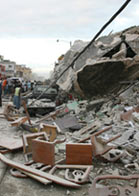
Like the 2004 tsunami that devastated southeast Asia, yesterday's catastrophic earthquake in Haiti, a poverty-stricken country with a legacy of home-grown violence and suffering, inevitably provoked the terrible question: where was God?
One answer derives from Jewish religious sources, and specifically from the teachings of the Kabbalah. It has to do with tzimtzum, or contraction: that is, God's own contraction and limitation of Himself in order to make space for the finite—and invariably flawed—worlds of physical nature and human action. The idea was most famously developed in Safed, Palestine by the 16th-century kabbalist Isaac Luria as part of a complicated, esoteric myth of cataclysm, creation, and the direction of world history.
Despite its obscure origins, tzimtzum has proved surprisingly resonant to contemporary Jewish thinkers who find meaning in it for everything from organizational life to individual psychology. The very qualities that made it quasi-heretical in the 16th century—particularly its overturning of hallowed notions of divine providence and omnipotence—make it appealing today, including in attempts to explain otherwise inexplicable acts of mass evil or natural disaster.
And yet it was precisely in order to "justify the ways of God to man" that the idea of tzimtzum came into being, and there it will stand or fall. That, at least, was the view of the late philosopher Hans Jonas, and a similar view seems to underlie the German painter Anselm Kiefer's ambiguous rendering of the concept.
This may be an overly abstract or equivocal foundation on which to construct an argument for religious belief and practice. But in an age marked by scientific rationalism, a mistrust of hierarchy, and confusion begotten by historical trauma, a limited God may be all the God that some can bear.
Comments are closed for this article.